What does A2 level French actually mean?
What does A2 level French actually mean?
"What level do I need to be to take the A2?"
"Which tenses do I need?"
"How much will I have to speak?"
These are the questions I'm asked most about the A2. And the answer is usually reassuring.
A2 isn't about perfect French. It's about being able to make yourself understood in everyday life. Here's what that actually looks like.
Why people want A2
For many of my students, it starts with paperwork.
Since 1 January 2026, non-EU nationals applying for their first multi-year residence card (carte de séjour pluriannuelle) need to prove A2 level French. That means no more renewing a one-year card every year. For a first 10-year resident card, the level is B1, and for citizenship it's B2.
The rules only apply to a first application, there's an age limit (the A2 requirement applies if you're under 65), and some types of card are exempt. So always check your own situation on service-public.fr before you book an exam.
But residency isn't the only reason. A2 is really the first level where you can make yourself understood in almost every everyday situation. And that's what most people want.
What you can actually do at A2
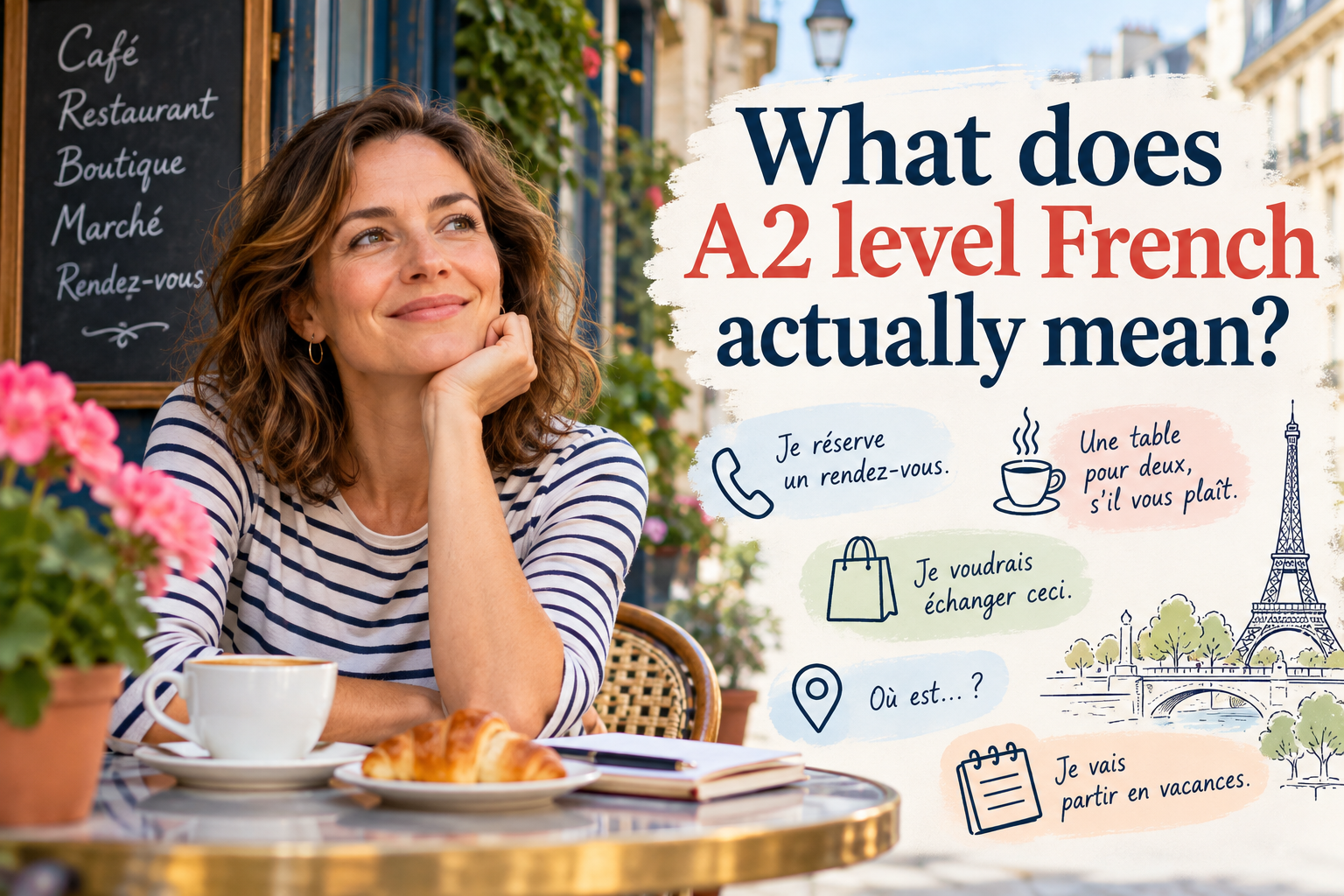
At A2, you can handle the situations that come up in real life in France. You can:
make a phone call to book an appointment, understand the date and time you're given, and change it if you need to
order in a restaurant or café, and make a special request
take something back to a shop and ask to exchange it
ask where something is in the supermarket, and understand directions
say what you did yesterday or last weekend, and what it was like
say what you're going to do later
spell your name and give your phone number, date of birth and email address without worrying whether you've got it right
That last one sounds basic. But anyone who has frozen while spelling their name over the phone knows how much confidence it gives you.
The grammar you need (and what you don't)
Here's what you need for a good A2 grade.
The perfect tense (passé composé) to say what you did: J'ai mangé au restaurant. Je suis allé au marché.
You don't need lots of it. Just enough to talk about a few things you've done.
The near future to say what you're going to do. This is the easy one: aller + infinitive. Je vais acheter du pain. On va partir en vacances.
Simple connectors to link your ideas: et, mais, puis, parce que.
Questions. You need to be able to ask them, not just answer them.
What you don't need
The imperfect tense. Two set phrases will do the job: c'était (it was) and il y avait (there was/there were). C'était super. Il y avait beaucoup de monde.
The subjunctive. Definitely not.
Perfect spelling. Nobody expects it at A2.
A huge vocabulary. As long as you can communicate, that's what matters.
The same goes for listening and reading. At A2, you need to pick out details and understand the main point. You don't need to work out the deeper reasons behind things. That comes at B1.
How much will I have to speak?
Less than most people think. The speaking test lasts about 6 to 8 minutes, in three parts:
A short interview about you: your life, family, home and hobbies.
A two-minute monologue on a topic you choose from two options.
A role play with the examiner, such as a conversation in a shop.
You get 10 minutes to prepare the monologue and role play beforehand, and you can take your notes in with you.
Here's what I tell my students before the day.
Walk in, say bonjour and smile. Nerves are completely normal, and examiners are used to them.
Always give an opinion, and explain it with parce que. J'aime la mer parce que c'est relaxant scores better than j'aime la mer.
Pauses are fine. A short pause sounds like thinking, not failing. It's also fine if the examiner has to prompt you.
You don't need a perfect accent. You need to be understood.
Run out of things to say? Invent a cousin. Bring in a cousin or a neighbour who thinks the opposite of you: Par contre, mon cousin préfère la montagne. It adds content and shows you can contrast ideas. You don't have to tell the truth in a DELF exam!
On the other side of the table
For 20 years, I was the one conducting oral exams, for GCSE and A-level students in England.
Then I sat the DELF myself. I took the B2, partly because I'll need it for my citizenship application, and partly because I wanted to know exactly what my students go through.
It felt strange to be the one being examined. And even though I knew B2 wouldn't be difficult for me, I still had a few nerves before I went in.
But the people running it were lovely and very reassuring. It wasn't an unpleasant experience at all. Mostly because I was ready, and I knew what to expect.
That's the real secret. Most nerves come from not knowing what's coming.
So, are you ready for A2?
If you can deal with everyday situations, talk about what you did and what you're going to do, and ask a few questions, you're probably closer than you think.
What often holds people back isn't their French. It's not knowing how the exam works.
My course Passing the A2 DELF Exam takes you through every part of the exam, with practical lessons, exam strategies and guided practice. So you walk in knowing exactly what to expect.